Why AI adoption lags behind what AI can do
Anthropic's own research shows a wide gap between what AI could do in each job and what it is actually used for. Here is why, and how to close it.

In March 2026, Anthropic's economics team published Labor market impacts of AI: A new measure and early evidence. One chart in it explains why companies like ours exist.
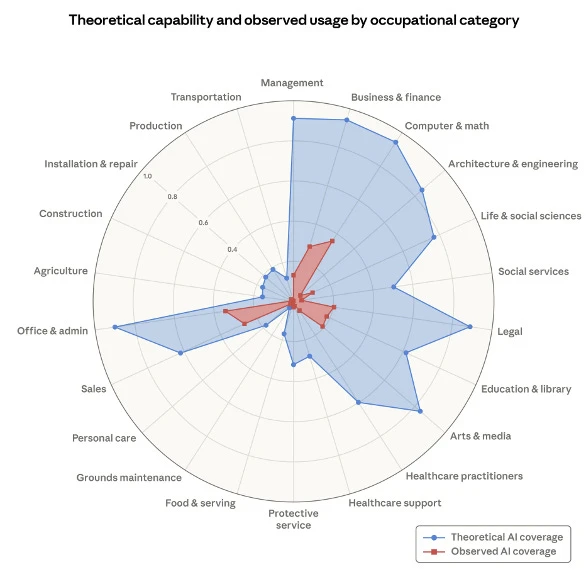
What the chart shows
The blue area is what AI could do. It uses an academic measure (Eloundou et al.) that scores each task in a job by whether a language model could speed it up, alone or with tools built around it.
The red area is what AI is actually doing. It is built from real, work-related Claude usage in the Anthropic Economic Index.
The gap is the story. In Computer & Math, language models could in theory handle 94% of tasks; in observed usage, Claude covers 33%. Office & Admin scores 90% in theory. Across management, business and finance, legal, and arts and media, the blue reaches far out and the red stays close to the centre.
Why the red lags behind the blue
Anthropic names the reasons itself. Some tasks are limited by what today's models can do. Many others are slow to spread because of legal constraints, specific software requirements and human verification steps.
From where we sit, inside client teams, those hurdles look very concrete:
- The work lives in systems, not in a chat window. A task is only automated when the AI can read from the ERP, write to the case system and respect the permissions. Someone has to build that.
- Nobody owns the last step. A pilot proves something can work. Turning it into something that runs every day, with monitoring and a fallback, belongs to no one, so it stalls.
- There is no baseline. If you never measured how the work is done today, you can't prove the AI version is better, and risk and legal will rightly say no.
- Verification is designed in late. Human checkpoints are treated as a brake instead of part of the system, so every edge case becomes a reason to stop.
- Data is messy and local. The fields that matter are half-filled, the exceptions are handled by phone, and the real rules are in people's heads.
None of these are model problems. They are deployment problems.
Read the chart carefully
A few honest caveats, most of them from the report itself:
- The red area measures Claude usage only, from Anthropic Economic Index data covering August and November 2025. Other tools are not in it.
- The blue area rates tasks against language-model capabilities as of early 2023. Models have improved since, so the theoretical ceiling may now be higher still.
- Rare tasks may not appear in usage samples at all.
The report also finds no systematic rise in unemployment for the most exposed workers so far, with suggestive signs that hiring of younger workers has slowed in exposed jobs. The gap in the chart is not yet a wave of replacement. It is unused capacity.
How the gap closes
The blue area is a map. The red area is the voyage. You don't close the distance by buying a better map.
It closes one workflow at a time: find the work that is ready, build the system where the work happens, measure it against today's numbers, and hand it to a team that owns it. That is what forward deployed engineering is for, and it is the method we use on every deployment.
The capability is already in your business. The work is carving it out.